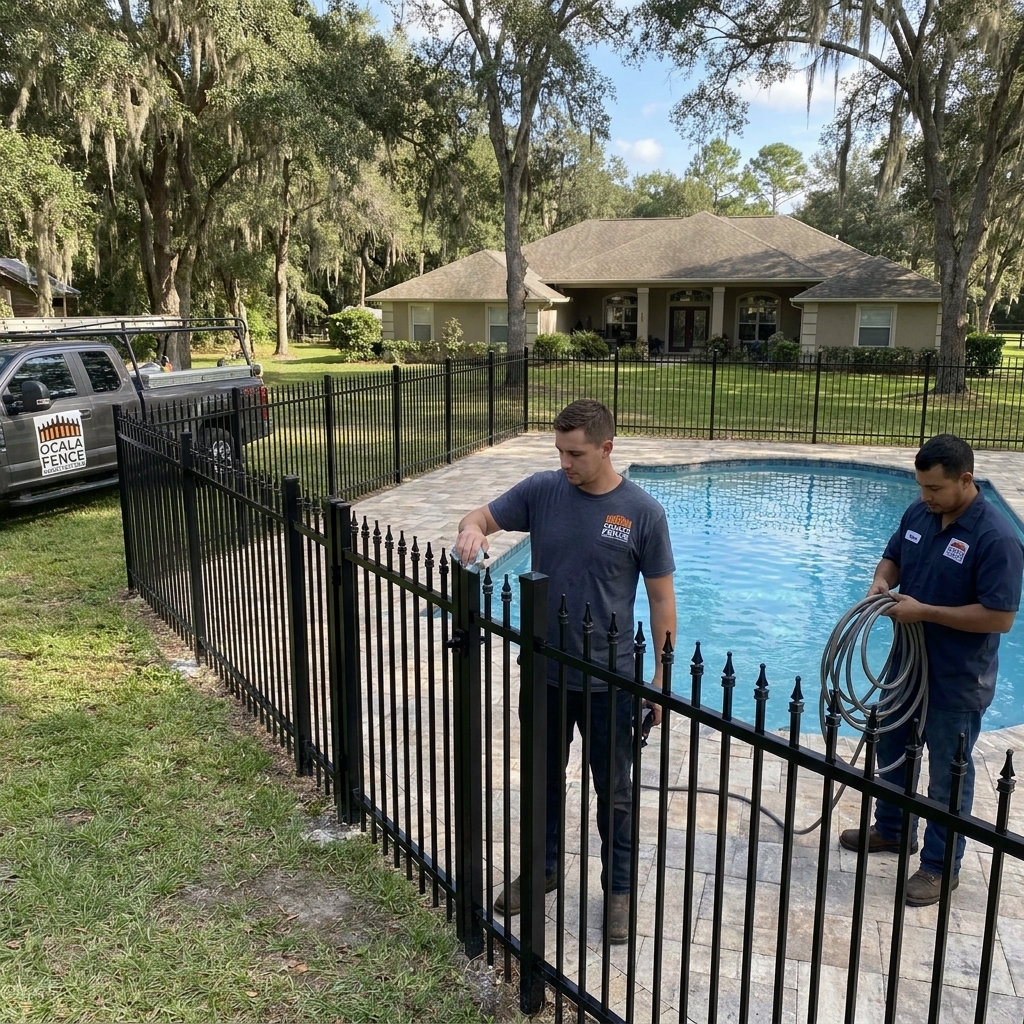
Florida's Residential Swimming Pool Safety Act
Florida's Residential Swimming Pool Safety Act requires new residential pools to have at least one of several approved safety features in place: an approved pool barrier (fence), an approved pool cover, exit alarms on doors and windows with direct pool access, or a self-closing/self-latching device on those doors. In practice, a compliant fence is by far the most common way homeowners and builders satisfy the requirement, since it works around the clock without depending on a homeowner remembering to arm an alarm or close a cover.
Marion County and the City of Ocala both enforce this standard through the local permitting process whenever a pool is installed or a property is sold with an existing pool, so it's worth having your barrier in genuinely good shape — not just technically present.
The Core Barrier Requirements
Height
The statewide standard calls for a barrier of at least 4 feet in height, measured from grade. We generally build pool fencing to 4 feet or taller depending on the material and the look a homeowner wants, since a taller fence rarely causes a compliance problem and often looks better anchoring a pool deck.
Gaps & Climbability
Vertical gaps in the barrier generally can't be wide enough for a small child to squeeze through — as a rule of thumb, no more than about 4 inches — and the fence design can't create an easy foothold or handhold a child could use to climb over. This is one reason aluminum ornamental fencing with closely spaced pickets is such a popular pool-fence choice in Marion County: it reads as open and attractive around a pool deck while still meeting the spacing standard.
Gates
Any gate in the pool barrier generally needs to be self-closing and self-latching, swing away from the pool (not into the pool area), and have its release mechanism mounted high enough — or positioned on the pool side of the gate — that a small child can't easily reach over and open it. We install pool gate hardware specifically to this standard rather than reusing a standard yard-gate latch.
What This Means for Your Ocala Pool Fence Project
If you're installing a new pool, adding a barrier as part of the build (or shortly after) keeps you compliant from day one. If you already have a pool with an older, non-compliant fence — gaps too wide, a gate that doesn't self-latch, a fence under 4 feet — we can evaluate what needs to change and whether a repair or a full replacement makes more sense. See our aluminum & ornamental fencing page for the style most Marion County homeowners choose around a pool, or our gate installation page for pool-code self-closing gate hardware specifically.
This article is general information, not legal advice. Pool barrier requirements can vary by the age of your pool, whether it's new construction or an existing pool, and specific local amendments. Always confirm your exact requirements with the Marion County Building Department or City of Ocala before finalizing a design — we're glad to build to whatever your inspector confirms is required.
PAA: Do I Need a Fence Around My Pool in Florida?
Does Florida law require a fence around a residential pool?
Florida's Residential Swimming Pool Safety Act requires every new residential pool to have at least one approved safety feature, and a compliant barrier (fence) around the pool is the most common way homeowners and builders satisfy it. Alarms, approved pool covers, and exit alarms on doors leading to the pool area are the other recognized options, but a fence remains the most reliable and lowest-maintenance choice for most homeowners.
How tall does a pool fence have to be in Florida?
Florida's statewide standard calls for a barrier at least 4 feet tall, with no gaps large enough for a small child to squeeze through (generally no more than 4 inches) and no horizontal footholds that make the fence easy to climb. We build pool fencing to meet this height and spacing standard as a baseline, then check for any additional local requirement tied to your specific address.
What are the gate requirements for a Florida pool fence?
Pool gates generally must be self-closing and self-latching, swing away from the pool, and have the release mechanism mounted high enough (or on the pool side of the gate) that a small child can't easily reach it. We install and position pool gate hardware specifically to meet this standard, not just a standard yard-gate latch.
Get a Pool-Code Fence Quote in Ocala
We install and repair pool fencing across Ocala, On Top of the World, and every Marion County community with a backyard pool. Get your free pool fence estimate here or call us at (352) 763-3520.
Also see: Wood vs. Vinyl vs. Aluminum Fencing for Florida Homes and Do You Need a Permit for a Fence in Marion County?